
Virtual team building activities that work, matched to the problem your team has (2027)
Most virtual team building fails because it is scheduled, performed and unrelated to the work. These activities are matched to the problem your team has, with how to run each one.
The virtual team building activities that work are short, optional and close to the work. A twenty-minute walk with a colleague on the phone. A weekly photo thread. A small thing built together in a day. The ones that fail are the Friday quiz that everyone attends with their camera off and their email open.
This guide sorts activities by the problem your team has. A team that has never met needs something different from a team that has met a hundred times and is tired. Each activity says how long it takes and what to watch for. The situations are illustrative, not customer stories. If you run a remote team of 10 to 100 people, some of them will sound familiar.
Why most virtual team building falls flat
Picture the Friday quiz. It starts at 4pm because that is when the calendar is empty. Twelve of fourteen people join and four have their cameras on. The host asks about 1990s films, two people answer, and the same two answer the next question. By 4.35 someone has quietly left. The following week the invite goes out again and a few more people decline.
Nothing in that quiz is wrong. The host worked hard and the questions were good. The trouble is what it asks of people, which is to perform fun in front of their manager at the end of the week with nothing riding on it. In an office, team building was a side effect of sitting near each other. You learnt that Priya hates meetings before ten because her desk was next to yours. Virtual team building tries to schedule that side effect, and a scheduled side effect feels like what it is.
Three tests are worth running before you try anything. Does it happen inside working hours, so nobody gives up an evening? Can someone skip it at no cost, so the people who turn up want to be there? Does it leave people knowing something useful about a colleague, such as how they like to be asked for help? Activities that pass all three tend to survive past the second month. When a team fails the third test over and over, the problem is usually wider than activities, and our piece on remote employee engagement without surveillance goes into it.
When people have never met
A new team, a batch of new hires, a company that grew from eight to thirty in a year. The aim here is simply to get to know each other. Early on, a short reply or a late answer gets read in the worst possible light, because there is nothing else to read it against. Once you know a colleague likes to think before replying, a slow answer stops looking like a problem.
The most useful activity is a half-page called how to work with me. Everyone writes one in fifteen minutes. It covers when they do their best work and how they like to receive feedback. It says what a short reply from them usually means, and one thing people tend to misread about them. Put the pages in a shared doc and give people a week to read them. Then spend twenty minutes live, in pairs, with one question each. The pages replace months of guessing, and managers often learn more from them than from a year of one-to-ones.
A lighter option is a weekly show and tell of the thing nearest your keyboard. Ninety seconds, one person, at the start of a regular meeting. A mug, a plant that is struggling, a view of a car park. The car park is fine. Keep it optional and keep it about objects rather than homes, because some people do not want a camera pointed at their kitchen.
For new joiners, book three twenty-five minute calls in week one with people outside their team. Each call has one question, what do you wish someone had told you in your first month? The answers are good, and the new person leaves the week with three names they feel able to message. Our 30-day remote onboarding plan shows where these calls fit.
When everyone is tired of video calls
If your team already spends six hours a day on camera, another video activity is a cost, however fun it is. The fix is to move the activity off the screen or off the clock.
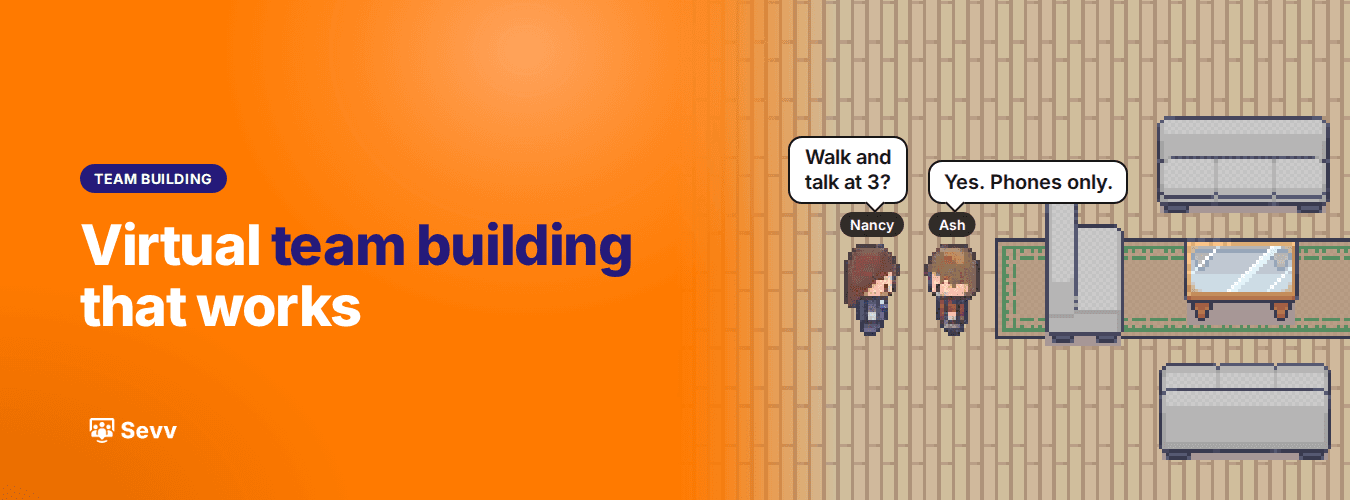
Walking one-to-ones are the cheapest option. Two people agree on a twenty-minute slot, each goes outside with a phone and they talk with no agenda and no camera. Pair people across teams and swap the pairs each month. It sounds too simple to matter. People tend to say things while walking that they would not say across a table, and neither of them is looking at a screen while they say it.
The weekly photo thread takes thirty seconds a week. One person posts a prompt on Monday. It might be the view from where you are working, or the oldest thing on your desk. Everyone replies with a photo when they feel like it. Nobody has to join a call. After a month you know what half the team's windows look like, which is oddly close to knowing them.
A shared playlist where each person adds one song a week, with no explanation required, does similar work for people who would rather not write anything. Teams tend to find the first month awkward and the third month hard to stop. If you want to go further on how to keep these quiet channels useful, our guide to remote team communication covers which kind of message belongs where.
When you work across time zones
Live events across eight hours of difference mean the same people give up their evening every time. Be honest about that and choose activities that never need everyone in one place at once.
Recorded three-minute show and tells are the best of these. Each person films one on their phone about something they know that has nothing to do with the job. How to fold a paper crane, why their city's tram map is wrong, the correct way to make tea. Post them in a channel and ask colleagues to reply in writing with one question. The videos take no scheduling and the replies are where the conversation happens.
A follow-the-sun scrapbook works in a similar way. It is a shared page where each person adds one photo or link when their working day begins. By the time the last time zone wakes up, the page has changed shape, and they can see who was there before them. It is a small thing, and it gives a spread-out team a shared surface that belongs to nobody in particular.
Pairs with a one or two hour overlap are worth setting up as well. Give each pair a standing twenty-five minute call every fortnight and change the pairings every quarter, so the same two people do not end up carrying the awkward hour forever. If you are working out how to manage a team that rarely overlaps, our guide to managing remote employees is a good next read.
When the team is big enough to form cliques
Somewhere between thirty and a hundred people, a company stops being one team. Engineers know engineers. Support knows support. The people who sat together at the offsite still do. Nobody planned it and it takes about a year to notice.
Fortnightly cross-team pairs are the standard answer, and they work better with a prompt than without one. Two strangers on a call with no topic spend ten minutes on the weather. Give them a question, such as what is the most annoying part of your week that nobody can fix, and the call becomes useful as well as pleasant. Several virtual watercooler tools automate the pairing if you would rather not do it by hand.
Shadow hours are less common and better. One person spends an hour watching a colleague from another function work, over a screen share, then swaps. A designer sees what a support queue looks like on a bad day. A support lead sees how long a small change takes to ship. Both go back to their own work with a different picture of the people on the other side.
The quiz deserves a second chance here. Run it in working hours, cap it at forty-five minutes and draw the teams from across departments on purpose. The mixing is the point. Tell people the score does not matter, and mean it.
When you want trust, build something together
Trust grows when you rely on someone and they come through. Most team building skips that part, because it is easier to organise games than shared work. If you want to build trust, give people a small piece of work that only exists if they do it together.
A one-day ship is the cleanest version. Four people from different parts of the company get a day to ship something tiny and internal. A better expenses page would do, or a script that tidies a report. No one gets tickets or sprint points for it. It needs a decision on Monday and a result by Friday. At the end they show it to everyone in ten minutes.
A skills swap is a lighter option. Fifteen minutes, one person teaching something unrelated to their job, once a fortnight. Bread, chess openings, how to read a train timetable in Japan. The best sessions come from people nobody expected to volunteer, and the topic often turns out to be a better introduction to them than their job title.
Postmortems of things that went well are the one we like most. Teams run postmortems on failures and rarely on successes, so the people who quietly made something work never hear what they did. Pick a recent win and ask each person what someone else did that they never got to thank them for. The room gets warmer quickly. Our guide on how to build remote team culture explains why recognition in public does so much of the work.
Running them without it getting awkward
The host goes first, and goes smaller than feels necessary. If the activity asks for a photo of something on your desk, the host shares a photo of a stapler. People copy the depth of what they see. A host who shares something large teaches everyone that large is the price of entry.
Cameras stay optional, and so does attendance. Keep activities inside working hours and put them on the calendar so they never feel like extra work. Rotate who hosts, so it does not become one person's second job. Ask for opinions rather than confessions. Favourite biscuit is a good question and childhood fears are not.
Give every activity a fair trial and then judge it. If fewer than half the invited people turn up three times in a row, change it or drop it, and tell the team you did. People trust a host who stops running something that is not working.
The signs that something is working are small. People reply to each other in the photo thread without the host prompting them. Someone mentions a skills swap three weeks later. A new hire knows who to message about something that is not their job. None of this shows up in a survey, and all of it shows up in how fast a question gets answered on a Tuesday.
What an office gave you for free
Every activity above exists to replace something. In an office nobody organised the moment when you saw that a colleague was free and walked over. It happened because you could see them. A list of activities cannot supply that. A remote team that tries to replace all of it with scheduled events ends up with a calendar full of them.
Teams that can see who is around, and start a conversation without sending an invite, need fewer organised activities. A team that bumps into each other needs fewer quiz nights.
Sevv is a place where you can bump into each other again from your desk at home. It is a virtual office with desks, meeting rooms and a lounge, in the browser with no headset, and it opens to teams on 14 December. Be first in line when we open.