
Remote employee engagement: how to build connection without surveillance (2026 guide)
Remote workers are engaged and lonely at once. Learn to build real connection, recognition and trust without surveillance, backed by 2026 data.
Remote employee engagement has become one of the most confusing topics in modern people management. Older studies found remote workers reporting high satisfaction and real autonomy, yet newer data says they are more likely to experience loneliness and less visible to leadership than their in-office peers.
Both trends are happening in the same workforce, which is why so many People Ops leaders feel like the old engagement playbook has stopped working.
This guide covers what remote employee engagement actually means, why the 2026 numbers make it harder to ignore, and eight strategies you can put into practice without adding a layer of monitoring software. The goal is connection built on trust. If your team has ever tried a mandatory virtual happy hour and watched it fall flat, you already know why that matters.
What is remote employee engagement?
Remote employee engagement is the degree to which distributed employees feel connected to their work, their team and their company, along with the habits that keep that feeling strong even though nobody shares a room. It differs from remote employee productivity, which measures output, and remote employee satisfaction, which measures how people feel day to day. Engagement sits underneath both. It is why an employee speaks up in a meeting, stays through a rough quarter instead of quietly job hunting, and cares whether the company succeeds as well as whether their own task list gets done.
For a distributed team, engagement has to be built on purpose. In an office, connection often happens by accident, through a hallway conversation or a shared lunch. Remote teams do not get those accidents, so belonging, recognition and trust have to be designed into how the team works.
Why it matters now
The urgency behind remote employee engagement shows up in hard, dated numbers every year. Gallup's State of the Global Workplace: 2026 Report found that only 20 percent of employees worldwide were engaged in 2025, the lowest level since 2020 and the first time global engagement has fallen for two years running.
The decline hit managers hardest. Manager engagement fell from 27 percent to 22 percent in a single year, the biggest one-year drop in Gallup's 2022 to 2025 figures, and it closed the old gap between manager and team engagement. That matters most for remote teams, since a struggling manager tends to drag an entire distributed team down faster than almost anything else.
Gallup estimates low engagement cost the global economy close to $10 trillion in lost productivity in 2025, roughly 9 percent of global GDP. For a remote or hybrid company, that is the difference between a team that compounds and one that quietly loses its best people.
At a glance:
- Only 20% of employees worldwide were engaged in 2025, the lowest level since 2020.
- Roughly $10 trillion in lost productivity a year, about 9% of global GDP, is the estimated cost of low engagement.
- Manager engagement fell to 22% in 2025, down from 27% the year before.
The real drivers of engagement, and which are hardest to deliver remotely
Strip away the buzzwords and employee engagement comes down to a short list of human needs: clear expectations, recognition, belonging, growth, wellbeing, autonomy and trust, and a manager who has their back. Those needs are the same at a kitchen table as in a cubicle. What changes is how hard each one becomes to meet once a team spans time zones instead of a single floor.
- Autonomy and trust (easy): remote work is built on giving people control over their own schedule and process.
- Clear expectations (moderate): written communication has to carry the weight that tone of voice and body language used to carry.
- Growth and development (moderate): mentorship and stretch assignments need deliberate scheduling instead of hallway visibility.
- Wellbeing (moderate): fewer natural breaks between home and work make burnout easier to miss.
- Recognition (hard): praise dropped in a Slack thread rarely lands the way it does when a manager says it in front of the team.
- Connection and belonging (hard): the informal, unplanned interactions that build belonging in an office do not happen by accident when nobody shares a room.
Of everything on that list, the manager relationship is the single biggest lever. Gallup's research consistently finds managers account for most of the difference in how engaged their teams are, more than perks, mission statements or any single policy. That is why a resilient engagement strategy equips managers directly, a thread running through the strategies below.
How to maximize remote employee engagement: eight strategies
The strategies below run roughly from fastest to implement to most structural, and none require adding monitoring software.
1. Fix the meeting tax before adding another all-hands
Fellow's State of Meetings report, which analysed more than 30,000 companies, found the average employee spends 11.3 hours a week in meetings, nearly 28 percent of the workweek. Separately, Flowtrace's State of Meetings report notes that remote employees attend roughly 50 percent more meetings than in-office peers. Audit existing meetings before adding a new one, and cancel anything that survives purely out of habit.
2. Build recognition into the daily rhythm
Recognition that only happens once a year, in a formal review, arrives too late to shape how someone feels about their work. Build it into daily communication instead, through a specific callout in a team channel, a contribution named in a weekly update or a quick peer-to-peer thank you.
3. Protect the 1:1 and keep it about the person
A weekly 1:1 that turns into a status meeting wastes an opportunity, especially when it may be the only unplanned time a remote employee gets with their manager all week. Protect it for two questions instead, how this person is doing and what is in their way, and push status updates into async written channels instead.
4. Design against proximity bias on purpose
Proximity bias is not a rumour. Live Data Technologies found that remote workers were promoted about 31 percent less often than people who work in the office, a group that includes hybrid workers, and, per Euronews' coverage of the same data, were about 38 percent less likely to receive bonuses. The fix has to be structural: documented promotion criteria, rotated visibility on projects and calibration reviews that weigh remote and in-office contributions side by side.
5. Make belonging structural
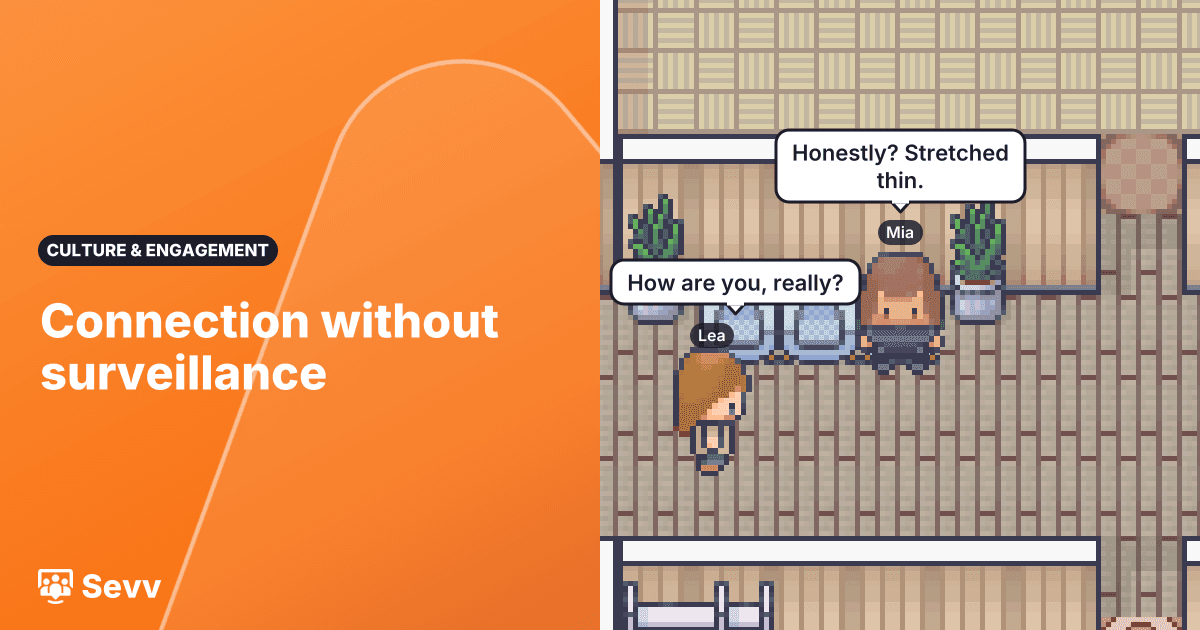
In an office, belonging often builds itself through small, unplanned moments, a hallway conversation or a shared coffee run. Remote teams do not get those moments unless someone designs them in, which most meeting-only tools miss entirely. A virtual office where teammates can see who is around and casually walk over for a quick word, the way Sevv's employee avatars work, recreates some of that feeling without a calendar invite.
6. Give autonomy real teeth
Most companies say they trust remote employees with autonomy, but plenty still track hours or require a visible green dot at all times, which tells employees the opposite. Real autonomy means judging people on outcomes. It is easy to deliver remotely if leadership resists swapping physical oversight for digital.
7. Treat burnout as a system problem
Remote work removes the natural boundary between arriving at work and leaving it, which makes burnout easier to build and harder to notice from outside. Wellness perks treat burnout as a personal failing, when it is usually a workload problem that sits with the system. A protected 1:1 will catch early signs of it faster than any pulse survey.
8. Make culture something people do
A culture deck full of values and a culture people actually experience are two different things, and remote employees notice the gap fastest, since office rituals are not there to reinforce what leadership says. Culture, for a distributed team, shows up in small defaults: whether meetings start on time, whether async updates get the same respect as live attendance, whether recognition happens in public. Get these right and the deck describes something already true.
How to measure remote employee engagement without watching people
Measuring engagement does not require tracking keystrokes or auditing hours logged, and doing so tends to erode the trust engagement depends on.
A short, frequent pulse survey, three to five questions sent monthly rather than fifty once a year, gives leadership a real-time read without becoming a burden.
Employee Net Promoter Score (eNPS), the simple question of how likely someone is to recommend their company as a place to work, is one of the most useful numbers to track over time, since it tends to shift before turnover does.
The richest signals, though, are usually qualitative: what comes up in a well-run 1:1, whether people show up to optional rituals versus mandatory ones, and whether survey feedback actually leads to visible change. A team that sees its feedback acted on keeps giving honest answers. A team that watches nothing change quarter after quarter eventually stops telling the truth, which quietly breaks the system.
What working remote taught us
We have lived most of the advice in this guide. Teams that work remotely for years learn quickly which rituals people want to show up for and which ones only survive because attendance is required.
The research backs up that experience. A survey of 1,000 full-time employees by workplace software company Nulab found team bonding activities were 3.6 times more likely to be enjoyed when they were optional rather than mandatory, and that icebreaker exercises, the default go-to for forced team building, ranked as the least enjoyable, effective or valuable activity tested.
The pattern holds whether a team is in an office or spread across time zones. A ritual people choose to show up for tells you something true about how connected they feel. A ritual people are required to attend tells you nothing at all, except who was too nervous to skip it.
Building remote employee engagement that lasts
Remote employee engagement will keep being confusing for as long as companies try to solve a trust problem with monitoring software. The teams pulling ahead in 2026 treat connection, recognition and belonging as things worth designing on purpose, the same way they design onboarding or compensation.
If you are rethinking what that looks like for your own distributed team, we would be glad to talk it through with you. Connect with the Sevv team here.