
Remote team culture is built from small moments that repeat. Here is how to write down your norms, make presence visible and give people a reason to talk.
Remote team culture is built the same way office culture was, through small moments that repeat. How people ask for help, how a decision gets made, who notices when someone goes quiet. To build it on purpose, write down how your team works, make it easy to see who is around, give people contact with no agenda, onboard new hires into relationships and recognise good work where everyone can see it.
Most founders already know this. What they lack is the Tuesday version. A question that would have taken thirty seconds at a desk waits for a calendar slot on Thursday. The standup runs with four of six people never unmuting. The designer in week three has met their manager and one other person, and has stopped expecting more.
Nothing in that Tuesday is anyone's fault. The people are competent and the tools work. What is missing is structure, because in an office the structure came free with the building. Remote teams have to build it themselves, and it is very buildable. This guide covers what to do, in roughly the order to do it.
What remote team culture is made of
Culture sounds large, so teams treat it as a project with a launch date. A values workshop, a page in the handbook, a logo on a mug. Those are fine. They are also not where culture lives.
It lives in the answers to small questions. Can I message my manager at 8pm without it meaning something? If I disagree in a meeting, does anyone follow up afterwards? When I finish something hard, who finds out? Each answer is learned by watching what happens the first few times, and after a few months it just becomes how things are here.
In an office, many of those answers were visible by accident. You saw the founder eat lunch at their desk and learned something. You overheard a difficult client call handled well. Remote work removes the accident, so the team has to supply that information on purpose. That is the whole job, and everything below is a way of doing it.
Write down how you actually work
The first thing to build is the least exciting. A short page on how your team works. Write the real version, the one that describes a normal Tuesday, and leave the aspirational one for the careers site.
Start with response times. Does a message sent at 4pm need an answer today, or by lunchtime tomorrow? If nobody has said, everyone guesses, and the anxious ones guess early. You end up with a team that checks Slack at 9pm and a manager who cannot work out why people seem tired.
Then decide what belongs in a meeting and what belongs in writing. A useful rule is that decisions get written down and discussions can happen live. Say whether cameras are expected. Say who can book whose calendar. Say what happens across a time zone gap, and who covers the late call when it falls to the same person three weeks running. Each of these takes a sentence, and together they save months of low-level friction. Our guide to remote team communication goes further on which channel suits which kind of message.
Keep it under two pages. Read it out at your next all-hands and ask what is wrong with it. The corrections are the useful part, because they show you the gap between how you think the team works and how it does.
Make it easy to see who is around
The cheapest thing an office does for culture is let you see people. You notice that Priya is at her desk, that Tom looks stuck, that the two engineers in the corner are deep in something and should be left alone. None of that is a feature of the building. It is presence, and presence is the first thing a remote team loses.
A green dot in a chat app does not replace it. The dot says a laptop is open. It does not say whether the person is free for a two-minute question, in a meeting or eating a sandwich. So people take the safe option, which is to send a message and wait. Messages pile up, and a small question becomes a thread with eleven replies.
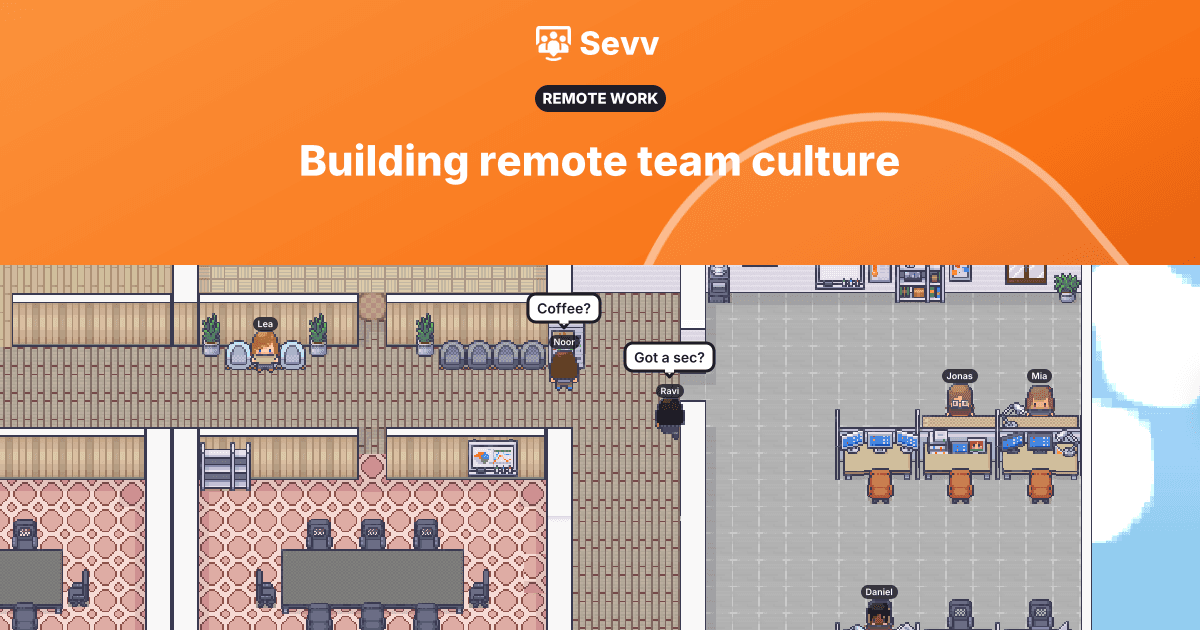
Teams solve this in different ways. Some set shared working hours with an open call that people drop in and out of. Some adopt a status convention that means something, such as a rule that a focus status is respected for two hours. Some use a virtual office, where you can see who is at their desk, who is in a meeting room and who is in the lounge, and walk over to talk. Which one you pick matters less than whether people can see each other without having to ask.
We make one of these tools, so we have put our own limits next to everyone else's in our comparison of virtual office software. Read it with that in mind, and pick whatever fits how your team already behaves.
Give people contact that has no agenda
Most remote teams only talk when there is a reason. Every conversation has a calendar invite, a topic and an end time. That is efficient, and it is also how you get colleagues who know each other's job titles and nothing else.
Culture needs the other kind of conversation. Two people talk about a bad commute for four minutes, and then one of them mentions that a deploy is looking risky. The second half only happens because of the first.
You cannot schedule that directly, but you can make room for it. Open hours work well. A manager sits in a call for an hour a week and anyone can join, with or without a question. A coffee chat that pairs two random people every fortnight costs nothing and gets people talking to someone outside their own team. Pairing on real work for an hour does a lot as well, because it gives two people a reason to talk with a built-in end.
Keep all of it optional. Compulsory fun is the quickest way to make people resent a good idea. If the Friday quiz is attended by the same five people and the other thirty-five feel judged for skipping, it has become a test. Run fewer things, make them easy to join and make leaving cost nothing. Loneliness is the risk underneath all of this, and we cover what helps and what backfires in our piece on remote work loneliness.
Onboard people into relationships
Culture is most fragile in the first month. A new hire in an office absorbs it through the walls. A remote one gets a laptop, six logins and a welcome message from someone they have never spoken to.
A good first week has people in it. Give the new hire a buddy who is not their manager, and put a thirty-minute call with that person in the calendar before day one. Book short intro calls with the five or six people they will actually work with, and ask each of them to send a line beforehand about what they do and what they are working on. By Friday the new hire should know who to ask for each kind of help.
Then watch week three. This is where remote hires tend to go quiet. The welcome has faded, the work has become real and nobody has noticed that they have not spoken to anyone outside their team. A fifteen-minute check-in from the manager, asking who they have worked with and who they would like to meet, catches the problem while it is still small.
Recognise good work in public
Remote work hides effort. In an office, the person who stayed late to fix an outage was seen doing it. Remotely, the fix lands in a channel at midnight and the only evidence is a green tick. If nobody says anything, that person learns that effort goes unseen, and adjusts.
Recognition is the cheapest culture tool you have, and it works best when it is specific. "Great job on the launch" is pleasant and forgettable. "Dana rewrote the billing export so it stopped timing out on large accounts, which is why Monday's support queue was empty" tells everyone what good looks like.
Leaders set the pattern. If the founder thanks people in public, others copy it within weeks. If recognition only flows down from the top, it reads like a performance review by another name. So encourage people to thank each other, and give it a home, such as a channel with one rule: every message names a person and a thing they did. Our piece on building connection without surveillance covers the other side of this, which is how to stay aware of how people are doing without watching what they do.
Listen more than you measure
Teams of 10 to 100 rarely have a people-analytics programme, and they rarely need one. A few simple signals tell you most of what you need.
Ask one question every month, the same one, in writing. "In the last two weeks, who outside your own team have you spoken to?" The answers show you which parts of the company have lost touch with each other, and they show it long before anyone complains.
Watch the standup. If the same two people do the talking and the rest never unmute, that tells you something about how safe it feels to speak. Watch who joins the optional things and who has stopped. Read your exit notes properly. Often the reason someone leaves is that they never felt they belonged, and it took a year for anyone to find out.
Do not turn any of this into a score. The moment people think their camera time or message count is being counted, they will game it, and you will have built a surveillance system by accident. You can get to know your team by asking them.
Where to start on Monday
Pick one thing from each section above and put a date on it. Write the how-we-work page this week. Choose the place where people can see each other and try it for a month. Set up the fortnightly coffee pairing. Add a buddy and a week-three check-in to onboarding. Open a channel for thanks.
Then leave it alone for a while. Culture gets built through repetition, so the early results look like very little. People answering faster. A few more unmuted standups. Someone mentioning they had coffee with a person from finance. Those are the signs it is working, and they arrive quietly.
A good remote culture feels like somewhere people want to walk into on a Tuesday.
Sevv is a virtual office with desks, meeting rooms and a lounge, in the browser with no headset, and it opens to teams soon. Join the waitlist.