
Remote work loneliness solutions: what helps and what backfires (2026)
Remote work loneliness has practical fixes. Learn what helps remote teams feel connected, what backfires, and how to tell it is working without surveillance.
Remote work loneliness has practical fixes, and most of them are small. The ones that work put people in each other's company often, for short stretches, without a calendar invite. That means regular cowork time, buddies for new joiners, managers who ask about connection, a few rituals people can skip and a shared space where presence is visible. Surveys, perks and one more all-hands do very little. This guide covers what to try first, what to drop, and how to tell it is working in a team of 10 to 100.
Here is the Tuesday most remote leaders will recognise. Standup at ten, and four of six people have their cameras off. A Slack thread collects two thumbs-up and no replies. Someone finishes a hard piece of work at three and has nobody to tell. Nothing is broken and everyone is competent. The day simply contained no human contact that was not scheduled or about a ticket. (This is an illustrative day, not a customer story.)
Why remote work loneliness belongs to the team
Gallup's 2025 State of the Global Workplace research found that 27% of fully remote workers had felt lonely the previous day, against 23% of hybrid workers. That gap looks small until you read it alongside the rest of the report. Fully remote workers were also the most engaged group, and 57% of them worldwide were looking for another job, either actively or in the background. Engaged and lonely at once is a combination worth taking seriously.
The cause is structural. An office produces contact as a by-product. You pass someone on the way to the kettle, you overhear a problem you happen to know the answer to, you eat lunch near people you did not plan to eat lunch with. Remote work removes the passing. Every conversation now needs a reason and a time, and most of the small ones never get either. Our guide to remote employee engagement covers the wider problem of being committed to the work and cut off from the people.
Loneliness at work rarely looks like sadness. It looks like a colleague who answers every message in one line and has stopped suggesting things. It also looks like a strong performer who has quietly stopped volunteering for anything. These are small changes, easy to read as a mood, and a manager with eight reports across three time zones will miss most of them.
What tends to backfire
The virtual happy hour at five on a Friday usually draws the people who need it least. The rest attend out of politeness, keep a camera on and leave the moment it is polite to. Mandatory fun is still mandatory.
More meetings add contact of the wrong kind. A daily all-hands is one person talking and forty listening, and nobody leaves it feeling closer to anyone. If your calendar is already the problem, our remote team communication guide shows how to cut meetings without losing the thread.
Wellness perks on their own miss the cause. A meditation app subscription is a fine thing to offer. It treats loneliness as an individual health matter when the cause is how the team works. Activity monitors and green-dot tracking go further in the wrong direction, because they tell people they are being watched, and nobody feels close to a person who is watching them.
Connection can be built, and the fixes that work are small enough to feel safe and regular enough to become a habit. The first costs almost nothing.
Start with pairs
Large groups hide lonely people. Pairs do not. The cheapest fix we know is a standing pairing. Every two weeks, each person gets twenty minutes with a colleague outside their own team. No agenda, no notes, no follow-up. A spreadsheet and a shuffle formula are enough to run it.
People talk about the weekend, the project they are stuck on, the odd thing their manager said. In a quarter, a ten-person company can have everyone paired with six different colleagues. A fifty-person company ends up with ties between departments that no org chart ever showed.
Make it opt-out. Lonely people rarely volunteer, and the ones who most need a coffee chat are the least likely to ask for one.
Give people a reason to work near each other
Cowork sessions borrow an idea from libraries. Two hours, audio open, everyone doing their own work. Nobody presents. Someone says they are back in five minutes and someone else says fine. The point is company, and company makes small remarks possible. Does anyone know how to export this? Has anyone seen that error before?
A Tuesday and a Thursday morning slot is enough to start. Cameras stay optional, because a person can feel accompanied without being looked at. Keep the first month going even if attendance is thin. People watch for a few weeks before they trust that a session will still be there.
Make the manager the first line of defence
Managers see loneliness first and name it last. Add one question to the weekly one-to-one: "Who did you talk to this week that wasn't about a ticket?" The answer tells you more than a quarterly survey. If the answer is nobody, you have found something useful. Treat it as a scheduling problem you solve together, never as a performance issue.
It also helps when managers go first. A lead who mentions their own quiet week gives everyone else permission to say the same. Our guide to managing remote employees has more on running one-to-ones that people value.
Meet in person, on purpose
Remote-first does not have to mean never in the same room. Two offsites a year, planned around conversation instead of presentations, do more than a weekly all-hands. Add a small meetup budget so colleagues in the same city can have lunch, and give those lunches a reason. A quarterly planning day beats a trip with no agenda.
The aim is shared stories, the in-jokes and half-remembered mistakes that make the next video call easier. If flights are the main cost, keep the first gathering small and put the people who work together most in the same room.
Protect the first 30 days
The loneliest week at a remote company is a new hire's first. They know nobody, cannot see who is around, and cannot judge what is normal. Give every new joiner a buddy outside their team and a daily fifteen-minute slot for the first two weeks. Tell the buddy that the job is to answer small questions fast.
Most new hires never ask whether it is okay to ask for help. A buddy answers it before they have to say it out loud.
A simple pattern for the first month. Week one is the buddy, the daily slot and two introductions to people outside the team. Week two adds a pairing from the fortnightly rota. By week three the new joiner should have had a casual conversation with at least five colleagues, none of them their manager. At day 30, ask who they would message with a question that has nothing to do with the job.
Look after the edges of the team
Some people are lonelier than the average because of where they sit on the map. A developer in Lisbon on a team based in San Francisco starts work with nobody online and finishes just as the others sign in. A designer who is the only employee in their city has no colleague within a two-hour drive.
Fix the first with overlap. Agree two or three hours when everyone is reachable, and rotate the awkward meeting slot so one person does not always take the late call. Pair people with a buddy in a nearby time zone. Fix the second with a coworking budget. A day pass once a week is a small line in the accounts and puts the person in a room with other people. Invite both groups to the cowork sessions that match their hours.
Build rituals people can skip
Rituals work when joining is optional and leaving costs nothing. A Friday show-and-tell where anyone can share something they made. A Monday thread for weekend photos. A monthly film or book club. Keep each one small, under eight people, and keep it regular, because habits form around a fixed slot rather than an announcement.
Let people join with audio only. Let them leave halfway. A ritual that forces attendance becomes one more thing on the calendar.
Where a virtual office fits
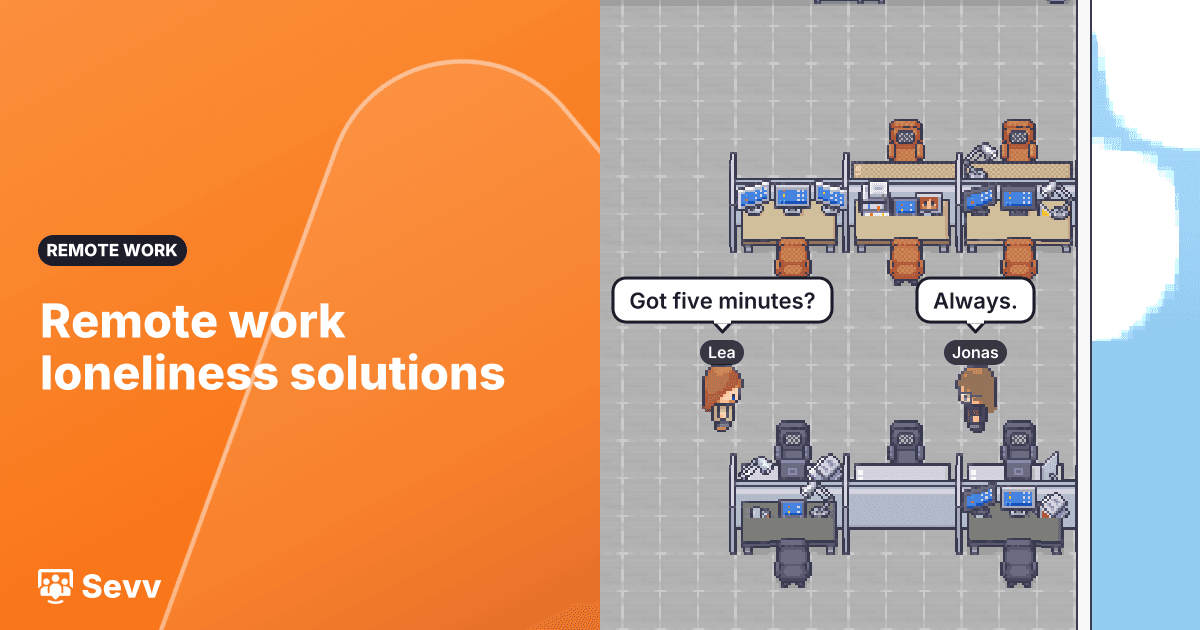
Everything above works better in a place where presence is visible. A virtual office does that. Sevv is a browser-based office with desks, meeting rooms and social spaces. Proximity audio and video means you hear the people near you and nobody else, so you can walk over to a colleague the way you would in a physical office. There is no headset to find and no invitation to send.
Picture the same Tuesday again, in the same illustrative company. Standup happens in a meeting room, and afterwards two people stay behind because they are already there. At three, the person who finished the hard piece of work sees a colleague at the next desk, walks over and says it out loud. Nothing was scheduled and nobody sent an invite. A small thing happened that the day did not contain before.
It is one tool inside a larger set of habits, and it will not fix a team that never talks. What it does is make the small, unplanned conversations possible again, which is the thing remote work took away.
How to tell whether it is working
Skip dashboards that count keystrokes. Ask one question each quarter, "How connected do you feel to the people you work with?", scored from one to five with room for a comment. Track the trend rather than the number. Watch the quiet signals, such as who has stopped joining the optional things and which team has no contact across the line. Then ask a person, not a spreadsheet. Our remote employee engagement guide covers measuring engagement without surveillance.
Remote work took away the corridor. Put one back.
Sevv opens to teams soon. Join the waitlist and see what a Tuesday looks like with a corridor in it.