
Ask remote workers what they miss about the office and they say the people. Push a little further and the answer splits into five specific things, each with its own fix.
Ask people who work from home what they miss about the office and almost everyone gives the same answer. The people. Hardly anyone says the commute. Push past that first answer, though, and it splits into smaller, more specific things. The joke you only got because you were in the room. Learning the job by overhearing someone better at it. Being noticed without having to post about it. Knowing how the company is doing from the mood on the floor. A working day that ended when you walked out of the door.
Those are worth separating, because each one needs a different fix. A remote team that treats them as one problem tends to reach for the same answer every time, another scheduled social, and that answer only touches one of them. This piece goes through each in turn, with what a team of 10 to 100 people can do about it this month.
The people, more precisely
The surveys agree on the headline and get interesting in the detail. In a 2020 poll of 2,000 UK home workers, office jokes and light-hearted conversation came top at 41%, just ahead of colleagues themselves at 40%. Routine and bouncing ideas off each other were close behind. In a JLL survey from the same year, 61% named human interaction as what they missed most, and 46% named clear boundaries between work and personal life. Nobody listed the photocopier.
Those numbers come from the first year of mass remote work. Six years on, a growing share of people on remote teams joined after 2020 and have no office to miss. They are not nostalgic for anything. They simply never had the things on this list, which makes those things harder to spot and easier to leave out.
The joke you had to be there for
Office banter tops that list for a reason that has little to do with comedy. A running joke is a record of time spent together. The printer that only works if you say please. The client who always calls at 4.55 on a Friday. Nobody wrote these down, and newcomers learned them by being in the room when they came up. Getting the reference was a quiet sign that you belonged.
Remote teams still make jokes, mostly in writing, and a written joke does a different job. It is posted to an audience, it collects reactions and it can be judged by them. People with a dry sense of humour often stop bothering, because a line that would have got a smile across a desk sits in a channel with no response at all. The joke that does well in #random is a small performance. The one said under your breath to the person beside you was a small act of trust.
Teams can protect some of this. Leave five minutes at the start of a call before the agenda and let the conversation wander. Give each team a small chat of its own that the whole company cannot read. Notice who only jokes in private messages, because those people are often holding a team together. For the bigger picture of what happens when these small exchanges dry up, see why remote teams are lonelier than ever.
Learning by sitting near someone
Some of the best evidence for what distance takes away comes from a study of software engineers at a Fortune 500 company. Natalia Emanuel, Emma Harrington and Amanda Pallais compared engineers who sat in the same building as all their teammates with those whose teammates were spread across buildings. Before the pandemic, the first group received about 22% more online feedback on their code. When the offices closed, the gap largely disappeared. The effect was concentrated on junior engineers, who asked more follow-up questions when they sat near their mentors, and young engineers on co-located teams were much more likely to leave once that closeness was gone.
Notice that the feedback was written. Sitting together made people more willing to ask for a review, and more willing to come back with a second question. There was a cost, and the researchers measured that too. Senior engineers wrote noticeably less code when they sat near their teammates, because their time went into teaching. In an office, that teaching happened in the gaps of the day without anyone booking it. Remotely it has to be booked, and booked mentoring loses to a deadline almost every time.
Junior people also learned by listening. They heard how a senior colleague turned down a client without losing them, or how the head of support calmed a furious customer. None of that is in a handbook. Some of it can be rebuilt. Let new hires sit in on calls they have no role in. Ask senior people to talk a decision through out loud once a week instead of posting only the outcome. Our 30-day remote onboarding plan shows where to fit this into a new joiner's first month.
Being noticed without announcing it
In an office, people saw effort. They saw you still at your desk at seven because the release went wrong. They saw you looked tired on Thursday and asked if you were alright. Some of that visibility was unfair, and plenty of people are glad to be judged on their work alone. Losing it has a cost all the same, and the cost falls unevenly.
On a remote team, the work that gets noticed is the work someone posts about. People who are comfortable writing a cheerful update in a public channel do well. People who fix the problem quietly and move on stay invisible unless their manager goes looking. The same goes for strain. Nobody sees you look tired on a call with your camera off, so the first sign a manager gets is sometimes a resignation.
The fix sits mostly with managers. Credit people by name for specific things, somewhere others will see it. Ask the quieter people what they worked on this week, then repeat it to the team. Treat a long silence as something to ask about gently. Our piece on signs your remote team is quietly disengaging covers what that silence can mean.
Knowing how the company is doing
An office tells you things before anyone announces them. The floor gets quieter in the weeks before a reorganisation. The sales team cheers when a big deal lands, and everyone within earshot knows before lunch. The founder walks past with a different face on a bad day. You did not need a memo to know the mood.
Remote teams get the official version, usually at the next all-hands, often weeks after the people closest to it knew. In between there is a gap, and people fill it with guesses. Good news shared a month late lands as old news. A worry left alone for a month has time to grow into a rumour.
The habit worth building is small and frequent. Share good news on the day it happens, in a sentence. When something is uncertain, say so, and say when you will know more. At a company of 40 people this takes a founder about as long as a Slack message, and it does more for trust than a polished monthly update. We go into the rest of this in how to build remote team culture.
A working day with edges
The commute is the one part of office life almost nobody misses. In one 2020 survey, 58% named it as the thing they were gladdest to give up. What people do miss is what the commute did. It marked the point where one role ended and another began. Harvard Business School's Jon Jachimowicz calls this role transition, and his research found the journey gave people time to make it. Microsoft's researchers reached a similar view and built a virtual commute into Teams to give remote workers back a start and an end to the day.
Without that edge, the working day spreads. A 2020 NBER study found the average workday had grown by nearly 50 minutes in the first months of the pandemic. The 46% in the JLL survey who missed clear boundaries were describing exactly this. The laptop lives on the kitchen table, so there is always one more message to answer.
Anyone can rebuild a commute of their own, a walk round the block before opening the laptop and another after closing it. Teams can help by making the end of the day visible. When people can see colleagues heading off, leaving feels normal. When everyone simply goes quiet in a chat tool, nobody can tell whether the rest of the team is still working, and the most anxious person on the team ends up setting the hours for everyone. If you manage people across time zones, our guide to managing remote employees is a good next read.
What habits can rebuild, and what they can't
Most of the fixes above are habits, and habits work. They all depend on somebody remembering, though. Someone has to leave the five minutes at the start of the call, invite the new hire to listen in and post the good news the same day. In a busy week, the habits are the first thing to go.
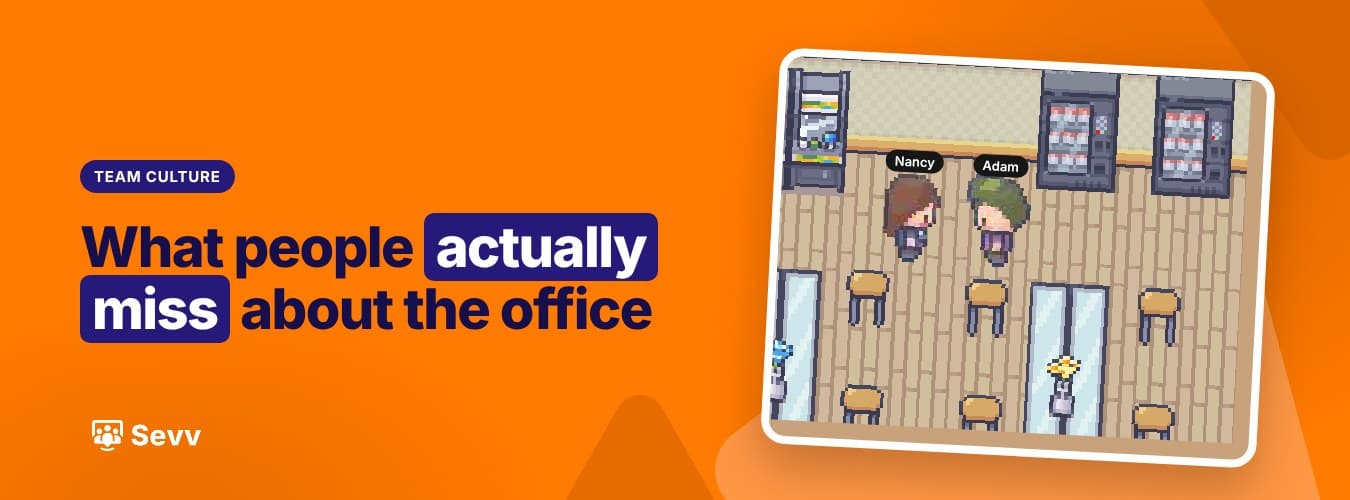
The office provided the setting where these things happened on their own. You overheard because you were near. You were noticed because you were visible. The day ended because you left the building. A remote team can rebuild some of that setting as well as the habits, and that is where a virtual office earns its place. It gives people a floor where colleagues can see each other and walk over, and a place you visibly leave at the end of the day.
Sevv is a virtual office for remote and hybrid teams. Your team gets desks, meeting rooms and a lounge. Proximity audio and video mean you hear the people near you, and the conversation fades as you walk away. A junior can sit beside a senior colleague. You can see who is around, and when someone heads off for the evening, everyone can see that too.
People rarely miss the building. They miss what happened because they were all in it.
We go live on 14 December. Be first in line when we open.