
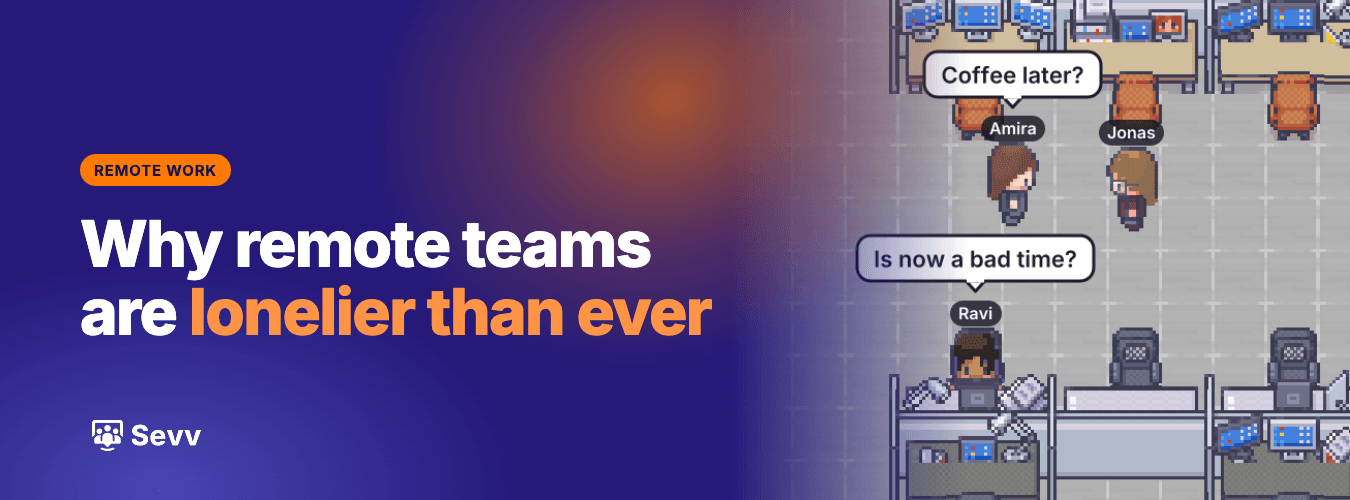
Remote teams run on relationships built somewhere else, and those are being spent faster than they are made. Here is why the loneliness numbers are not falling.
Remote teams are lonelier than ever because they run on relationships that were built somewhere else. People who spent years beside their colleagues carry those connections into remote work and spend them down slowly. Everyone who joins afterwards starts with no history with anyone, and a remote team gives them few ways to build any.
Gallup's 2026 global report found that 22% of employees felt lonely a lot of the previous day, and 24% of fully remote and hybrid employees did. The overall figure has not fallen since 2024. This article explains why.
The relationships were built before
Jim Harter, Gallup's chief scientist for workplace management and wellbeing, gave the clearest account of this we have seen. Speaking to Axios, he said older workers already have established relationships, so working remotely or in a hybrid pattern costs them little. Younger workers are still forming theirs, and that is hard to do from a distance.
The numbers fit. In Gallup's 2025 survey of US employees, 27% of remote-ready Gen Z employees working full time had felt lonely a lot of the previous day, against 10% of baby boomers and 15% of Gen X. The 2026 global report points the same way, with 23% of employees under 35 against 21% of those older. The same Gallup study found that only 23% of remote-capable Gen Z employees would choose to work fully remotely, against 35% of each older generation. The people with the least history with their colleagues are the least keen to work entirely apart from them.
Age looks like a stand-in here. A fair reading is that what sits underneath it is how long you have known the people you work with.
Picture two people in the same remote company, in the same role. Amira joined in 2019 and spent fourteen months in the office before everyone went home. Ravi joined in January. Amira can message almost anyone and expect a warm reply, because she knows who they are. Ravi has met four colleagues on video, can name perhaps a dozen, and has never been introduced to anyone outside his own team. Both are good at their jobs. Only one has savings to draw on. This is an illustrative pair, not real employees.
Ravi's manager can follow every point in a guide to managing remote employees and the gap will still be there, because a one-to-one is a relationship with one person.
Friendship takes hours, and meetings count for less
In 2018 the University of Kansas researcher Jeffrey Hall estimated how long friendship takes, studying adults who had recently moved and new university students. His work, published in the Journal of Social and Personal Relationships, put it at roughly 50 hours together to move from acquaintance to casual friend, about 90 to become a friend and more than 200 to become a close friend. He also found that time spent simply working side by side counts for less than other time.
That research was about new friendships rather than colleagues, so take what follows as an illustration. Do the sum for Ravi. If his main shared time with a colleague is one team meeting a week, fifty hours would take him close to a year, and that is before the meeting is split between six people and spent entirely on tasks. Amira got her hours the old way, over lunches and coffee queues and the long end of a Thursday, and nobody arranged any of them. Remote work removed the unscheduled hours, and those turn out to be the ones doing the work.
A network that only narrows
A peer-reviewed study of more than 61,000 Microsoft employees in the US, published in Nature Human Behaviour in 2021, tracked what happened when the whole company went remote in early 2020. Collaboration networks became more siloed. People talked more to the colleagues closest to them and added new contacts more slowly.
Put that next to Amira and Ravi. Amira's circle stays intact and gets a little tighter. Ravi's has nowhere to grow. Each person who leaves takes some of the old connections with them, and each person who arrives starts at the edge, so the stock of relationships a team can draw on shrinks even while headcount holds steady. That is arithmetic rather than a finding, but it matches what the study measured.
Time makes it worse. A company that went remote in 2020 took its office history with it. Six years later, a good share of the people who held that history have moved on, and the average person on the team never met them. No survey measures this directly, so treat it as reasoning rather than a result. It would explain why the loneliness numbers have not eased as remote work has become normal. Better written communication helps work run, as our guide to remote team communication explains, and it does not make introductions.
Why a growing company feels smaller
At twelve people, everyone is part of every conversation that matters. At sixty, nobody is. The company splits into teams of six or seven, each with its own channels, its own meetings and its own jokes, and the gaps between them are wide. The head of sales and the head of support might share a leadership call every week while their teams have never spoken.
An office hides this. On a sixty-person floor you can see the other fifty-odd people even if you never speak to them. You know who they are, who they sit with and when they are in. A remote company gives you a list of names instead. Nothing puts you in front of someone from another team, so nothing starts a tie with them.
This is the stage a lot of growing companies are at. Between 10 and 100 people, a company is large enough to split into groups and small enough to still expect everyone to know each other.
Reachable is not the same as known
A remote company has a directory. Every colleague has a profile, a photo and a status dot, and any of them can be messaged in two clicks. That feels like closeness, and what it measures is reachability. Someone can be reachable by all sixty colleagues and known by six.
Messaging a stranger asks them to stop what they are doing for a person they have never spoken to, so a lot of people never do. The directory shows who exists. Nothing in it says who would welcome a message, which is the thing you used to learn by sitting nearby.
Hybrid does not top it up
Hybrid employees reported the same 24% as fully remote ones. One possible reason is scheduling. Gallup found that two-thirds of remote-ready hybrid Gen Z employees must be on-site a set number of days but can choose which, so they can end up working in the office alone.
A hybrid policy decides how many days people are in. It does not decide whether they are in on the same days. Two colleagues can each be in the office three days a week and never overlap, which leaves them with a commute and the same silence they had at home.
One caution on all of these figures. They are self-reported answers to a single question about the previous day. The Gen Z figures come from a US survey of about 19,000 employees and the 2026 figures are global, and Gallup's 2026 report groups on-site workers differently from earlier editions, so the 24% and 22% are best read against each other rather than against numbers from two years ago. None of that changes the direction, which is the same in every cut of the data.
What it means for a team of 10 to 100
If connection is something a team spends, it has to be topped up on purpose, and that changes what is worth watching. List everyone who joined in the last twelve months and count how many have had a real conversation with someone outside their own team. Then look for pairs of teams that never overlap. Engagement scores will not show you either.
Managers are not a safe early-warning system. Gallup's 2026 report has managers at 23% and individual contributors at 21%, so the person you would expect to spot loneliness is about as likely to feel it.
We cover what helps and what backfires in our guide to remote work loneliness. The short version is to favour anything that puts people in front of colleagues they would not otherwise meet over anything that adds to the calendar.
Somewhere to meet people you were never introduced to
A virtual office gives the Ravis of a company what an office gave them without anyone arranging it, a chance to be seen by people outside their team and to start a conversation with them.
Sevv is a virtual office for remote and hybrid teams. There are desks, meeting rooms and social spaces, and the audio and video work by proximity. A new joiner can see who is around, walk up to a colleague from another team and start talking, with no invitation and no meeting link. It gives people somewhere to start, and what grows from there is up to them.
Relationships built last year will not carry a remote team through next year.
We go live on 14 December. Be first in line when we open.