
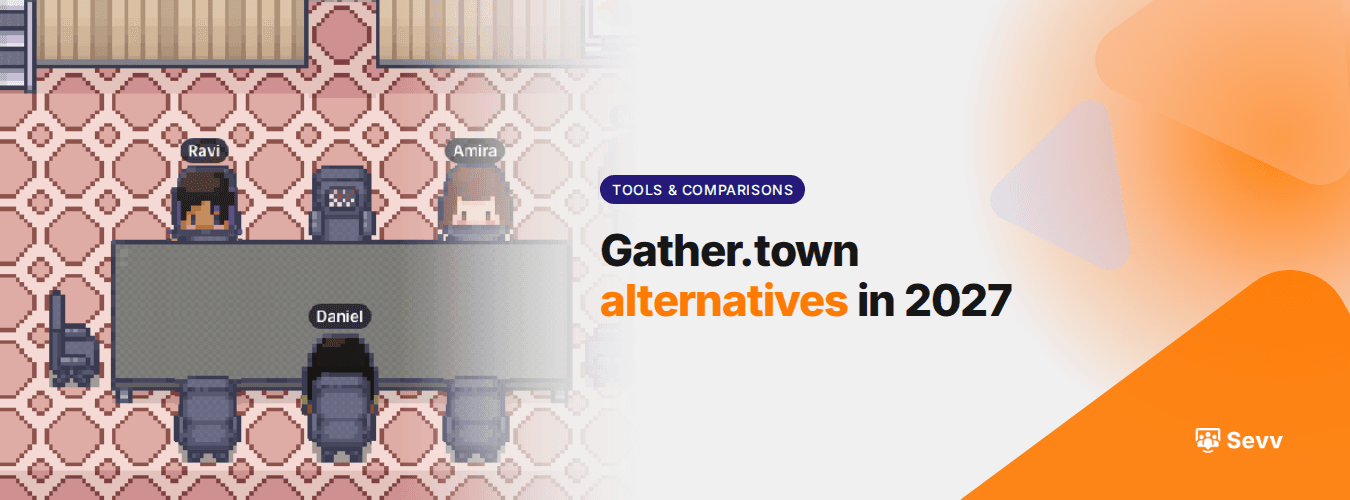
Gather.town alternatives in 2027, matched to the reason you are leaving
Gather.town now costs $15 per member a month and the free option is gone. These alternatives are matched to why teams leave, with prices for 10 to 100 people.
The best Gather.town alternative depends on why you are leaving. If the bill is the reason, look at Sevv, Teemyco and SoWork. If the pixel map is the reason, look at Kumospace and Teamflow. If you enjoy building maps and only the price bothers you, look at WorkAdventure. Gather now costs $15 per member per month, or $12 on annual billing, and the free option is gone. For 50 people that is $750 a month, against $249.50 on Sevv and $400 on Teemyco.
The renewal email arrives and the number is bigger than last year's. Most of the team has not opened the map since the summer. Someone asks whether it is worth keeping, and nobody has an answer.
This guide sorts the alternatives by the reason people leave, because a team with a price problem needs a different tool from a team with a map problem. We make Sevv, so our own price and limits sit in the same tables as everyone else's. Prices are in USD and reflect public vendor information as of October 2026. They change often, so confirm current rates with each vendor before you buy.
What changed at Gather
Gather explained the change in a help centre notice. On 15 September 2025 Gather moved both its original office, now called Gather 1.0, and its newer Gather 2.0 to one price. That is $15 per member per month, or $12 on annual billing. The free option ended the same day, and new offices now start with a 30-day free trial instead. Gather 2.0 also changed how you pay. Gather 1.0 charged by concurrent users, so you paid for how many people were online at once. Gather 2.0 charges per member, so you pay for everyone on the team whether or not they log in.
Teams on the old annual plans got a grace period. Gather let 1.0 customers lock in their existing annual rate, which was $5.95 per user per month, until September 2026. That window has now passed. A team that kept the old rate and renews at $12 is paying roughly double.
There is a second reason this is a good moment to compare. Moving from Gather 1.0 to 2.0 means setting up a new office in Gather Studio, Gather's map builder. If you are going to rebuild anyway, you can try something else for a fortnight first. Our guide to the best virtual office software for 2027 covers the wider field.
If the bill is the reason
Gather bills for every member, so the cost grows with headcount whether or not people turn up. This is what each option costs a month at four team sizes, on monthly billing.
10 people | 25 people | 50 people | 100 people | |
|---|---|---|---|---|
Gather | $150 | $375 | $750 | $1,500 |
Kumospace | $200 | $500 | $1,000 | $2,000 |
Teemyco | $80 | $200 | $400 | $800 |
SoWork (Basic) | $60 | $150 | $300 | $600 |
Sevv (Growth) | $49.90 | $124.75 | $249.50 | $499 |
Annual billing narrows the gaps without closing them. At 50 people, Gather comes to $600 a month and Sevv to $199.50. Teemyco is $300 and SoWork's Basic plan is $270. SpatialChat bought Teemyco in February 2026, so ask what happens to its roadmap and prices before you sign for a year. SoWork's lower tier leaves out the AI meeting tools, which sit in its $15 Premium plan.
flat.social prices by concurrent seat, which changes the sums. At $6 per seat per month, 50 people with 30 online at once need 30 seats and pay $180. That beats every per-member price here. The catch is that presence there is session-based, so nobody can see who is around between visits. For a team that wants to see who is at their desk at 9am on a Tuesday, that gap matters.
Sevv's Growth plan is $4.99 per user per month, or $3.99 on annual billing, for 1 to 100 seats. That is the lowest paid per-member price in this guide. Sevv opens on 14 December, and every team starts with 30 days free for the whole team. A card is required to start.
If the map is the reason
Gather's map builder is the reason many teams pick it. Competitors that court Gather users, such as SoWork and Katmai, say map editing has a steep learning curve and that the pixel look wears thin as a team grows. Those are vendor claims, so check them against your own team. Whoever builds the map also has to keep it up to date, so ask who that will be before you commit to any tool.
Kumospace is the closest in spirit. It runs in the browser, lets you brand the office with your own decor and takes little time to set up. It has the highest per-member price in the cost table above, at $20 monthly or $16 on annual billing, according to a comparison page from SoWork. A free option covers up to 5 members.
Teamflow suits teams that spend their day inside a few documents. Google Docs, Trello and Notion open inside the room, and whatever you leave in a room stays there. Its Seed plan is $20 per employee per month, or $15 billed yearly, and the free option covers 5 employees.
If the map itself is the part you love, WorkAdventure lets you keep building one. Its own site says you can import or recreate your Gather maps. It lists a free option for up to 15 concurrent users and paid plans from €5 to €10 per user per month. Treat that as the vendor's claim and test the import with your real map.
Sevv works from ready-made office templates today, with desks, meeting rooms and social spaces. A map editor is planned for the Pro tier, and avatar customisation is planned for the first quarter of 2027. If your team's favourite part of Gather is designing its own world, Sevv cannot do that yet.
If guests and events are the reason
Gather's pricing notice says a paid Gather 2.0 subscription includes at least 30 guest hours a month, and an office with 20 members gets 60. Guests cannot claim a desk or decorate the office. Whether the allowance is enough depends on how often clients and candidates visit. Gather 2.0 also left out some things 1.0 events had, including chat Q&A and guest moderation tools, and it has no daily reservations. Gather 1.0 events still cost $3 per user per day.
For public events, SpatialChat built its name on them. Its free option covers 2 hours a day for up to 12 participants. Day passes start at about $3 per user per day, and business plans start at about $79 a month for 25 users. flat.social lets guests join free from a link, and its Day Pass is $2 per seat per day with a 10-seat minimum. Sevv and flat.social both stop at 100 concurrent users, so a company-wide event of 500 needs an events tool.
For client visits and interviews, Sevv invites guests into the company's office and the host walks them round. A guest can use the features inside a meeting room and sees none of the company's own data, chat included. A candidate gets shown around a building, which a video link does not offer. If socials are what you used Gather for, our guide to virtual watercooler tools covers which formats last past week two.
If the reason is that nobody turns up
Check this one before you pay for anything new. If three of fifty people opened the map this week, the tool may be fine and the habit missing, and the next tool will go the same way. Ask what used to bring people in. If the answer is a Monday standup that happened in a Gather room, move the standup first and the software second. Our guide to building remote team culture covers the habits that get a shared space used.
What does help is presence that stays on. A virtual office works when you can see who is at their desk, walk over and start talking without sending a link. Sevv is built around that. Everyone has a desk, and there is a lounge for the conversations that do not need a door. Audio and video follow proximity. Whether the floor gets busier depends on the habits around it, so test it with the whole team and do not take our word for it.
Gather.town alternatives side by side
This table covers the tools that came up most in the sections above.
Gather | Sevv | Teemyco | SoWork | Kumospace | flat.social | |
|---|---|---|---|---|---|---|
Price, monthly billing | $15 per member | $4.99 per user | $8 per user | $6 Basic, $15 Premium | $20 per member | $6 per concurrent seat |
Price, annual billing | $12 per member | $3.99 per user | $6 per user | $5.40 Basic, $12 Premium | $16 per member | Check with the vendor |
Free option | 30-day trial, no permanent free option | 30-day free trial from 14 December, card required | 14-day trial | Up to 10 members, 30-minute meetings | Up to 5 members | Up to 5 people at once |
Look and feel | Pixel-art map you build | Ready-made templates, map editor planned for Pro | Rooms with availability status | Immersive map or simpler view | Branded decor in the browser | Playful, with built-in games |
Strongest point | Deep map customisation | Lowest paid price per member and a walk-over office | Persistent rooms at a low price | AI meeting summaries on Premium | Quick setup, nothing to install | Games and free guest links |
Watch out for | Price roughly doubled for teams that held the old annual rate | New product, 100 concurrent users, no map editor yet and integrations still arriving | Owned by SpatialChat since February 2026 | AI tools sit in the $15 tier | Highest price in the cost table | No always-on status, 100 at once |
Best for | Teams that love designing a map | Daily presence for 1 to 100 people | A simple, low-priced office that stays on | Teams that want meeting notes written for them | Mid-sized teams that want a branded office fast | Events and socials |
How to move without losing a fortnight
Check your renewal date first, because it sets how long you can run two tools side by side. Then run the new one for two weeks with the whole team, not only the person who found it. Count who turns up on day five. That number tells you more than any feature list.
Expect your map and custom objects to stay behind, unless a vendor has shown you the import working. Tell regular guests where to go before you cancel anything. Decide which ritual moves first, and pick one. A ten-minute standup in a meeting room carries from one tool to the next without much fuss. Ask managers to sit at their desks from day one, because a quiet manager makes a quiet floor. Agree what a closed door and a muted mic mean. Our guide to managing remote employees covers how to set expectations that people keep.
When staying on Gather is the right call
Stay if your team enjoys building its map and the bill is one you are happy with. Stay if you run events on Gather 1.0 at the daily rate. Stay if you are under ten people and the sums are small. Gather's map builder is among the deepest in this guide, and a team that uses it every day is getting what it pays for. Moving costs a fortnight of attention, so move when the reason is real.
The same applies to us. Sevv is a new product, and integrations with calendar, Slack and project tools are still being added. AI summaries, recordings and Events Mode are planned for the first quarter of 2027. The map editor is planned for the Pro tier. Sevv supports up to 100 concurrent users today, so a company of 500 should look elsewhere for now.
Pick the tool your team will still be opening in March.
Sevv opens on 14 December. Be first in line.
Related Posts
Best virtual office software platforms for remote teams in 2027
Virtual office tools for remote teams in 2027, compared on real cost and daily fit, with a side-by-side look at Gather, Teemyco and Kumospace.
How to build remote team culture that people actually feel
Remote team culture is built from small moments that repeat. Here is how to write down your norms, make presence visible and give people a reason to talk.
Virtual watercooler tools that remote teams still use after week two
Chat channels, pairing bots, video socials and virtual offices all claim to be a virtual watercooler. Here is what each does well and where it goes quiet.